A long table of box makers
Folding boxes alone is quiet work. Folding them with twenty people around a table becomes something else.
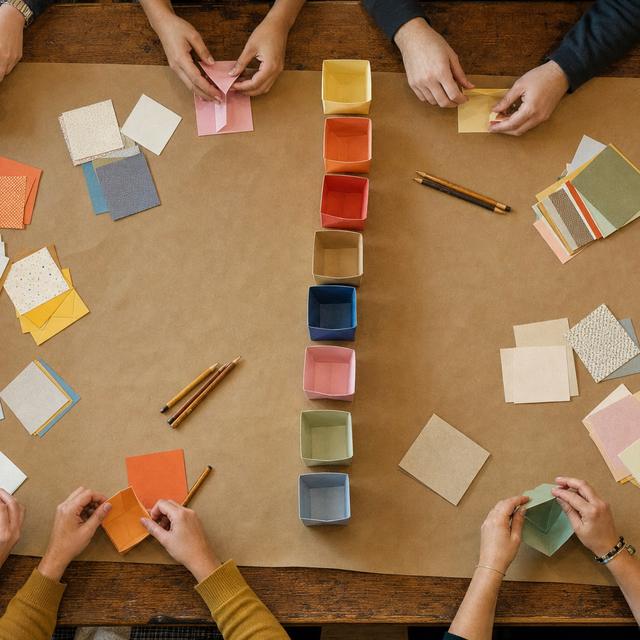
There is a reason quilting circles and barn raisings lasted so long. People who would never sit down to talk about something hard will happily talk while their hands are busy. A long table covered in paper squares, with a few finished boxes in the middle as examples, gives a room full of near strangers something to do together, and the conversation follows on its own.
Setting the table
Plan on about a metre of table per person, more if children are coming. Cover the table with kraft paper so glue and marker can go anywhere. Put the materials down the centre in reach of everyone: pre-cut squares in two or three sizes, bone folders or old credit cards for creasing, pencils, a few glue sticks, and a stack of thin card for floor inserts.
Pre-cutting matters. Cutting paper square by eye is slow and the results never fold true. A guillotine trimmer at home the night before turns two hundred sheets into squares in under an hour, and it means the session starts with folding instead of measuring.
Teaching the fold
Teach once, slowly, to the whole table, using a large square so the folds are easy to see from the far end. Then teach again to whoever needs it, one at a time. People learn this fold at very different speeds, and the quick learners turn into helpers within ten minutes. Pair them with the slow ones and step back.
Expect the first box from most people to be lopsided. Praise it and keep it. A crooked first box often ends up being the one its maker treasures most.
Children at the table
Children aged seven or eight and up can usually manage the fold with a little help. Younger ones do better decorating boxes that an adult has already folded, with stickers, stamps and crayons. Give them their own end of the table, a stack of paper they are allowed to waste, and a job they can finish. Children who finish early are glad to carry finished boxes to the middle of the table, and the job keeps them close to the adults without asking them to sit still for two hours.
Writing on the boxes
If the session is in memory of someone, or of many people, give each maker the option of writing a name, a date or a few words on the box. Some will write at length. Some will write nothing. Both are fine. Keep a few blank cards on the table for anyone who wants to write privately and tuck the card inside before closing the lid.
Have a box of tissues on the table where it does not have to be asked for.
Pace
Two hours is about right. The first half hour is noisy with instructions and questions. The middle hour settles into the steady sound of creasing and low conversation. The last half hour is for finishing, for looking at what everyone has made, and for gathering the boxes together.
Seeing the boxes together is often the strongest moment of the day. Fifty small boxes lined up on a table, each one different, each one made by a different pair of hands, gives a number a shape. People take photographs of it. People stand and read the names.
Afterwards
Decide in advance what happens to the boxes. Some groups let each maker take theirs home. Some keep them together for a display at a library, a church hall or a school. Some send them to a family. Tell people before they start, so nobody writes something private on a box that will be shown in public.
Clean up together. It takes ten minutes with everyone helping, and it gives the room one more task to share before people head back out into the rest of the day.